My neighbor Marco asked why I couldn’t just skip the step of creaming the butter and sugar together. I started to explain the science of aeration and why that would ruin the texture — then stopped. He was holding a container of fresh ricotta he’d just brought back from his family’s farm upstate, and honestly, I figured I’d let him be wrong in the most delicious way possible. I handed him the whisk and said, “Go ahead, show me what you’ve got.”
He dumped the ricotta straight into the bowl with the sugar, no butter at all. I wanted to grab it back. I mean, I’ve been making cookies for years, and you don’t just skip butter. But there was something about the way he shrugged, completely unbothered by my panic. “It’s spring,” he said, like that explained everything. “The ricotta is light. Trust it.”
So I did. I folded in the lemon zest and juice, watching the batter come together into something so soft and pillowy it barely looked like cookie dough. When I scooped it onto the baking sheet, it held its shape just enough. Fifteen minutes later, I pulled out the most tender, cloud-like cookies I’d ever made. The edges were barely golden, the centers practically melted on the tongue. Marco took one bite and just smiled. I stood there holding my spatula, fully aware I’d just been schooled by a guy who learned to cook from his grandmother’s intuition, not a recipe card.
That spring afternoon, I learned that sometimes the best technique is the one you haven’t tried yet. These Spring Lemon Ricotta Cookies with Lemon Glaze are the result of that humbling moment — a recipe that proves lighter, softer, and simpler can be exactly right. Maybe you’ve been there, holding onto a method just because it’s what you’ve always done. Trust me, let the ricotta do its thing. You won’t go back.
Why You’ll Love This Recipe
These aren’t your average cookie. The ricotta makes them almost cake-like in texture — tender, moist, and impossibly light. I’ve tested this recipe at least six times now, tweaking the glaze ratio and the bake time until it was absolutely foolproof. Here’s why it’s earned a permanent spot in my spring rotation:
- Quick & Easy: From mixing bowl to cooling rack in under 30 minutes. No chilling required, no stand mixer needed.
- Simple Ingredients: You probably have everything except the ricotta. No obscure flours or specialty extracts here.
- Perfect for Spring Gatherings: Bridal showers, Easter brunch, Mother’s Day tea — these cookies look like you fussed, but you didn’t.
- Crowd-Pleaser: I brought a batch to my book club and three people asked for the recipe before I’d even sat down.
- Unbelievably Delicious: The lemon is bright without being sharp, the glaze sets into a crackly shell, and the texture honestly feels like eating a lemon bar in cookie form.
What makes this version different from all the other lemon ricotta cookies out there? It’s the balance. I spent a whole afternoon testing different ratios of ricotta to flour, and this one gives you that signature tenderness without the cookies spreading into flat puddles. Plus, the glaze uses fresh lemon juice and just enough powdered sugar to stay glossy without being saccharine. It’s the kind of cookie that makes you close your eyes after the first bite — spring in a single, perfect mouthful.
What Ingredients You Will Need
This recipe uses simple, wholesome ingredients to deliver bright, sunny flavor and a texture that’s genuinely unforgettable. Most of these are pantry staples, with the ricotta being the star of the show.
- All-purpose flour — 1 ¾ cups (210g). Spoon and level it into your measuring cup for the most accurate result. I’ve tested this with King Arthur Flour and Gold Medal, both work beautifully.
- Baking powder — 2 teaspoons. This gives the cookies their lift. Make sure yours isn’t expired — fresh baking powder makes a real difference.
- Salt — ½ teaspoon. Just fine table salt. It balances the sweetness and brightens the lemon flavor.
- Whole milk ricotta cheese — 1 cup (240g). This is non-negotiable for the best texture. Part-skim ricotta has more water and will make the cookies denser. Look for a brand like Galbani or Calabro — the texture is creamier and less grainy.
- Granulated sugar — 1 cup (200g). Regular white sugar. It dissolves into the ricotta beautifully.
- Unsalted butter — ½ cup (113g), melted and slightly cooled. Yes, we’re using melted butter here, not creamed. It keeps the cookies tender and the process fast.
- Large eggs — 2, at room temperature. Cold eggs will seize the melted butter. If you forgot to set them out, place them in a bowl of warm water for 5 minutes.
- Fresh lemon zest — 2 tablespoons (from about 2 large lemons). This is where the bright, true lemon flavor lives. Don’t skip it — bottled juice won’t give you the same aromatic punch.
- Fresh lemon juice — 2 tablespoons (from about 1 lemon). Use the same lemons you zested. Save the rest for your glaze.
- Vanilla extract — 1 teaspoon. Pure vanilla, not imitation. It rounds out the tangy lemon beautifully.
For the Lemon Glaze:
- Powdered sugar — 1 ½ cups (180g), sifted. Sifting prevents lumps in your glaze.
- Fresh lemon juice — 2 to 3 tablespoons. Start with 2 and add more if needed for a drizzle-able consistency.
- Milk or cream — 1 tablespoon (optional, for thinning). Only if your glaze is too thick after the lemon juice.
Equipment Needed
You don’t need much for these cookies, which is part of their charm. Here’s what you’ll want on hand:
- Large mixing bowl — Any bowl will do, but a wide one makes mixing easier.
- Whisk — For combining the wet ingredients and smoothing out the ricotta.
- Rubber spatula — For folding the dry ingredients in without overmixing.
- Baking sheets — Two standard half-sheet pans work best. Line them with parchment paper for easy cleanup.
- Cookie scoop — A 1.5-tablespoon scoop gives you uniform cookies. No scoop? Use two spoons and your best judgment.
- Cooling rack — Essential for letting the glaze set properly. If you don’t have one, you can let the cookies cool on the baking sheet, but it will take longer.
- Small bowl — For whisking the glaze.
I’ve made these with a cheap baking sheet that warped in the oven, and the cookies still turned out fine. Don’t overthink the equipment — your hands and a bit of patience are all you really need.
Preparation Method

- Preheat your oven to 350°F (175°C) and line two baking sheets with parchment paper. This is a good moment to set out your eggs if they’re still cold.
- Whisk the dry ingredients together. In a medium bowl, combine 1 ¾ cups (210g) all-purpose flour, 2 teaspoons baking powder, and ½ teaspoon salt. Whisk until evenly distributed. Set aside.
- Mix the wet ingredients. In a large bowl, combine 1 cup (240g) whole milk ricotta, 1 cup (200g) granulated sugar, and ½ cup (113g) melted unsalted butter. Whisk until smooth and creamy — about 30 seconds. The ricotta should be fully incorporated, with no visible lumps.
- Add the eggs, lemon, and vanilla. Whisk in 2 room-temperature eggs, one at a time, until fully combined. Then add 2 tablespoons fresh lemon zest, 2 tablespoons fresh lemon juice, and 1 teaspoon vanilla extract. The mixture will look a little thin and smell incredible.
- Fold in the dry ingredients. Add the flour mixture to the wet ingredients. Use a rubber spatula to fold gently — just until no streaks of flour remain. Overmixing will make the cookies tough. The batter will be soft, almost like a thick cake batter. That’s exactly right.
- Scoop and bake. Use your cookie scoop to drop rounded tablespoons of dough onto the prepared baking sheets, spacing them about 2 inches apart. These cookies spread slightly but not dramatically. Bake for 12 to 14 minutes, rotating the pans halfway through. The cookies should be puffed, set around the edges, and barely golden on the bottom. The tops will look pale — that’s the ricotta working its magic.
- Cool completely. Let the cookies rest on the baking sheet for 3 minutes, then transfer them to a wire cooling rack. They’re fragile when warm, so use a thin spatula. Let them cool completely before glazing — about 20 minutes.
- Make the glaze. In a small bowl, whisk together 1 ½ cups (180g) sifted powdered sugar and 2 tablespoons fresh lemon juice. If the glaze is too thick to drizzle, add another tablespoon of lemon juice or a splash of milk. It should flow slowly off the whisk — not runny, but not stiff.
- Glaze the cookies. Dip the top of each cooled cookie into the glaze, letting the excess drip off. Place them back on the cooling rack, glazed side up. Let the glaze set for about 15 minutes before serving. If you’re impatient like me, you can eat one immediately — just know the glaze will be sticky.
Cooking Tips & Techniques
I’ve made about ten batches of these cookies in the last month, and I’ve learned a few things the hard way. First, don’t skip sifting the powdered sugar for the glaze. I did that once, and the glaze had tiny lumps that looked like sand. Not cute on a spring cookie.
Second, use fresh lemons. I know it’s tempting to grab that bottle of lemon juice from the fridge door, but the zest is where the real flavor lives, and you can’t zest a bottle. The difference between fresh and bottled in this recipe is night and day — fresh gives you that bright, floral note; bottled tastes flat and slightly bitter.
Third, don’t overbake. These cookies are meant to be soft and tender. If you wait for them to turn golden brown on top, they’ll be dry. Pull them out when the edges are just barely set and the centers still look slightly underdone. They’ll continue cooking on the hot baking sheet for those three minutes you let them rest.
One more thing — I learned the hard way that cold ricotta doesn’t mix as smoothly. Let it sit on the counter for 15 minutes before you start. And if your ricotta looks watery, drain it through a fine-mesh sieve for 10 minutes. Too much liquid will make the cookies spread into thin, sad discs.
Variations & Adaptations
These cookies are wonderfully adaptable. Here are a few ways I’ve played with the recipe:
- Lemon Blueberry Ricotta Cookies: Fold in ½ cup of fresh or frozen blueberries (don’t thaw them) right before scooping. The berries burst slightly during baking, creating little pockets of jammy sweetness. This is my favorite spring variation.
- Gluten-Free Version: Substitute the all-purpose flour with a 1:1 gluten-free baking flour blend (I like Bob’s Red Mill). The texture will be slightly more delicate, so handle the cookies gently when transferring them to the cooling rack.
- Lime or Orange Variation: Swap the lemon zest and juice for lime or orange. Lime gives a more tropical vibe, while orange makes them taste like a creamsicle. Use the same measurements.
- Dairy-Free Option: Use a high-quality dairy-free ricotta (Kite Hill makes a good one) and substitute the butter with melted coconut oil or vegan butter. The texture won’t be quite as tender, but it’s still delicious.
- Herb-Infused Glaze: Steep a few sprigs of fresh thyme or lavender in the lemon juice for 10 minutes before whisking it into the powdered sugar. Strain out the herbs before mixing. It adds a subtle floral note that’s perfect for spring.
Serving & Storage Suggestions
These cookies are best served at room temperature, with the glaze fully set. I like to arrange them on a white platter with a few fresh lemon slices and a sprig of mint for color — it makes them look like they belong at an afternoon tea party.
They pair beautifully with a cup of Earl Grey, a glass of iced tea, or even a crisp sparkling wine if you’re feeling fancy. For a spring brunch, serve them alongside fresh fruit and a yogurt parfait.
Storage: Keep the cookies in an airtight container at room temperature for up to 4 days. Layer them between sheets of parchment paper so the glaze doesn’t stick. Do not refrigerate them — the fridge will dry them out and make the glaze tacky.
Freezing: You can freeze the unglazed cookies for up to 3 months. Place them in a single layer on a baking sheet, freeze until solid (about 1 hour), then transfer to a freezer-safe bag. When you’re ready to serve, thaw them at room temperature, then glaze as directed. The glaze is best made fresh.
The flavors actually mellow and meld after a day, so these cookies taste even better on day two. If you can wait that long.
Nutritional Information & Benefits
Per cookie (based on 24 cookies): Approximately 145 calories, 6g fat, 21g carbohydrates, 3g protein, 12g sugar. These are estimates and will vary based on specific ingredients and glaze application.
The ricotta adds a surprising boost of protein and calcium, making these cookies a bit more substantial than your average sugar cookie. The lemon provides a good dose of vitamin C and antioxidants, plus it aids digestion — not that you’re eating cookies for health reasons, but it’s nice to know.
If you’re watching your sugar intake, you can reduce the glaze by half or skip it entirely. The cookies are still lovely without it — just a bit less fancy.
These cookies are vegetarian and can be made gluten-free or dairy-free with the substitutions listed above. They do contain eggs and dairy in their standard form.
Conclusion
These Spring Lemon Ricotta Cookies with Lemon Glaze are everything I want a spring cookie to be — bright, tender, and just a little bit unexpected. They came from a moment of being wrong, and honestly, I’m grateful for it. Sometimes the best recipes are the ones that challenge what you think you know.
I hope you make these for your next spring gathering, or just for a Tuesday afternoon when you need something sunny. Customize them however you like — add berries, switch up the citrus, go heavy on the glaze. They’re forgiving and flexible, just like a good recipe should be.
If you try them, I’d love to hear how they turned out. Leave a comment below or tag me in your photos. Happy spring baking!
Frequently Asked Questions
Can I use part-skim ricotta instead of whole milk?
You can, but the cookies will be slightly less tender and may spread a bit more. Whole milk ricotta has less water and more fat, which gives the cookies their signature soft texture. If you only have part-skim, drain it in a fine-mesh sieve for 15 minutes before using.
Why did my cookies spread too much?
This usually happens for one of three reasons: your ricotta was too watery, your butter was too hot when you mixed it in, or your baking powder is old. Make sure to drain watery ricotta, let melted butter cool for 5 minutes, and check that your baking powder is less than 6 months old.
Can I make the dough ahead of time?
Yes, you can refrigerate the dough for up to 24 hours. Cover the bowl tightly with plastic wrap. The dough will be firmer after chilling, so let it sit at room temperature for 10 minutes before scooping. You may need to add 1 to 2 minutes to the bake time.
How do I get a smooth, crack-free glaze?
Sift your powdered sugar before whisking, and add the lemon juice slowly. Whisk vigorously until completely smooth. If you see lumps, strain the glaze through a fine-mesh sieve. Also, make sure your cookies are completely cool before glazing — warm cookies will melt the glaze into a sticky mess.
Can I double this recipe?
Absolutely. This recipe doubles beautifully. Just make sure you have enough oven space — bake one sheet at a time on the center rack for the most even results. You can also freeze half the unglazed cookies for later.
Pin This Recipe!
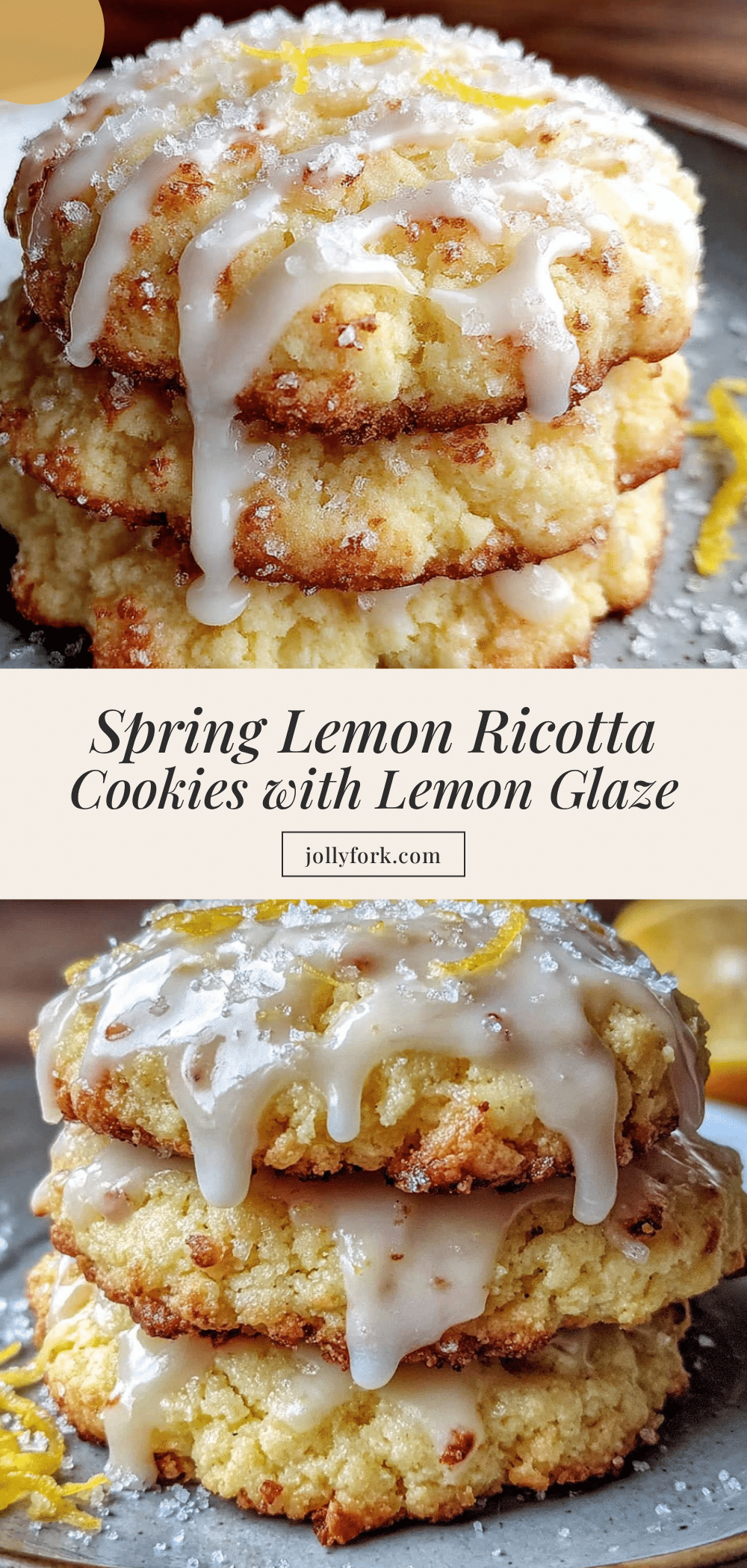
Easy Spring Lemon Ricotta Cookies with Lemon Glaze

These tender, cloud-like lemon ricotta cookies are bright with fresh lemon and finished with a glossy lemon glaze. Quick and easy, they’re perfect for spring gatherings and prove that sometimes the best technique is the one you haven’t tried yet.
- Prep Time: 15 minutes
- Cook Time: 12-14 minutes
- Total Time: 30 minutes
- Yield: 24 cookies 1x
- Category: Dessert
- Cuisine: American
Ingredients
- 1 ¾ cups (210g) all-purpose flour
- 2 teaspoons baking powder
- ½ teaspoon salt
- 1 cup (240g) whole milk ricotta cheese
- 1 cup (200g) granulated sugar
- ½ cup (113g) unsalted butter, melted and slightly cooled
- 2 large eggs, at room temperature
- 2 tablespoons fresh lemon zest (from about 2 large lemons)
- 2 tablespoons fresh lemon juice (from about 1 lemon)
- 1 teaspoon vanilla extract
- 1 ½ cups (180g) powdered sugar, sifted
- 2 to 3 tablespoons fresh lemon juice (for glaze)
- 1 tablespoon milk or cream (optional, for thinning glaze)
Instructions
- Preheat your oven to 350°F (175°C) and line two baking sheets with parchment paper.
- In a medium bowl, whisk together 1 ¾ cups (210g) all-purpose flour, 2 teaspoons baking powder, and ½ teaspoon salt. Set aside.
- In a large bowl, combine 1 cup (240g) whole milk ricotta, 1 cup (200g) granulated sugar, and ½ cup (113g) melted unsalted butter. Whisk until smooth and creamy, about 30 seconds.
- Whisk in 2 room-temperature eggs, one at a time, until fully combined. Then add 2 tablespoons fresh lemon zest, 2 tablespoons fresh lemon juice, and 1 teaspoon vanilla extract.
- Add the flour mixture to the wet ingredients. Use a rubber spatula to fold gently until no streaks of flour remain. The batter will be soft, like a thick cake batter.
- Use a cookie scoop to drop rounded tablespoons of dough onto the prepared baking sheets, spacing them about 2 inches apart.
- Bake for 12 to 14 minutes, rotating the pans halfway through. The cookies should be puffed, set around the edges, and barely golden on the bottom. The tops will look pale.
- Let the cookies rest on the baking sheet for 3 minutes, then transfer them to a wire cooling rack. Let them cool completely before glazing, about 20 minutes.
- In a small bowl, whisk together 1 ½ cups (180g) sifted powdered sugar and 2 tablespoons fresh lemon juice. If the glaze is too thick, add another tablespoon of lemon juice or a splash of milk.
- Dip the top of each cooled cookie into the glaze, letting the excess drip off. Place them back on the cooling rack, glazed side up. Let the glaze set for about 15 minutes before serving.
Notes
Use whole milk ricotta for best texture. Let ricotta sit at room temperature for 15 minutes before using. If ricotta is watery, drain it through a fine-mesh sieve for 10 minutes. Do not overbake; cookies should be soft and tender. Sift powdered sugar for a smooth glaze. Store in an airtight container at room temperature for up to 4 days. Freeze unglazed cookies for up to 3 months.
Nutrition
- Serving Size: 1 cookie
- Calories: 145
- Sugar: 12
- Sodium: 95
- Fat: 6
- Saturated Fat: 3.5
- Carbohydrates: 21
- Protein: 3
Keywords: lemon ricotta cookies, spring cookies, lemon glaze, easy cookie recipe, ricotta cookies